The honest check
Am I a good dungeon master? How to actually tell
"Am I actually any good at this?" Every DM I know has asked it, me included. You put hours into prep, the session happens, people laugh, someone types "good game" afterwards, and you still close the laptop wondering if they meant it. Your players are your friends, and friends are kind. Meanwhile the DMs you compare yourself to do this for a living, with an editor.
The good news is you already have better evidence than compliments, and most of it is sitting in your Discord server. Start with attendance, because nothing else comes close. Then there are five things you can actually check in your own game. No surveys, no fishing for praise.
The strongest signal: they keep showing up
Think about what it costs to be in your game. Three, four, five hours on a work night, every week, for months. People do not keep paying that for something they secretly dislike. Everyone has a colleague who "would love to come along" to the pub quiz and somehow never once has. When someone stops enjoying a thing they drift: the excuses get softer, the confirmations get slower, and eventually the session only happens if you chase everyone individually. A table that turns up on time, week after week, has already answered your question.
So look at your attendance before you look at anything else. If people pay you to DM, even more so; nobody books a second session with a DM they regretted paying the first time. And if your table does keep showing up, the rest of this guide is about getting better rather than getting reassured. You are allowed to want both. Most of us put real hours into prep and never hear anything more useful back than "that was fun", which is lovely, and tells you nothing.
- Green flags: full tables, on-time starts, players scheduling their week around the game.
- Amber flags: lateness becoming normal, "might have to skip this one" turning into a pattern, sessions that only happen when you chase.
- Not a flag: one bad month. Life happens; read the season, not the week.
Check one: who holds the spotlight
Some sessions belong to one character and that is fine. A backstory pays off, someone finally confronts the sister who sold them out, and everyone else is happy to watch it happen. The problem is when it is the same two or three voices every week while the same player rolls dice quietly in the corner. Almost nobody says "I feel left out" to their DM. They say "sorry, can’t make it this week" about four months later.
The by-hand check is simple and slightly humbling. After the next session, try to write down from memory who opened and closed each scene and who made the big calls. Whoever you struggle to remember is your answer. Give it two or three sessions before you trust the pattern, because one quiet night means nothing.
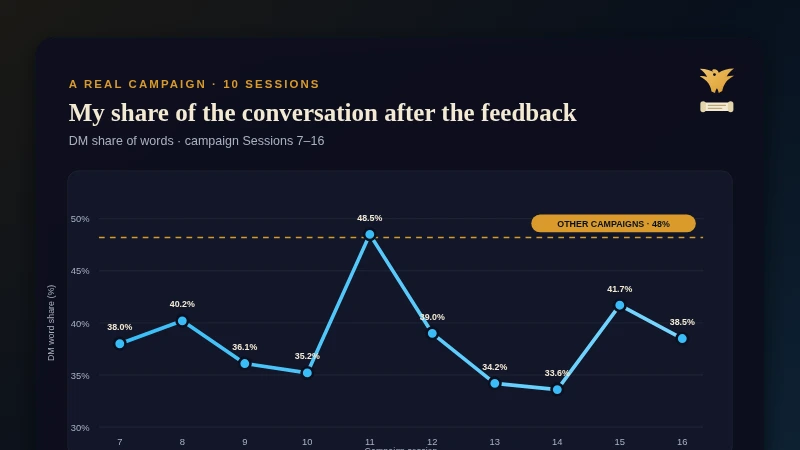
Recap Raven includes words by speaker on every plan. Premium adds session analytics, and Memory connects trends across the campaign. When someone has not had a scene of their own for three weeks it is right there on the report, and you can aim the next hook at them on purpose.
Check two: where the hours actually go
Ask a DM how long the big fight took and you will get an honest, wrong answer. You act on every single turn, so combat moves for you. Your players are sitting through six other turns to cast one cantrip. A fight that felt tense from behind the screen can genuinely have been forty minutes of waiting per player, and nobody is going to tell you that afterwards.
The experiment costs you one session: jot the start time of each scene and mark it combat, social, or exploration. It is cheap, mildly annoying to remember, and usually surprising in one direction or the other. Either the "quick" fights took half the night, or the session you sold as intrigue turned out to be mostly travel and shopping.
Memory plans log the split and show the trend across the campaign, which has a second use: when a prospective player asks what kind of game you run, you can answer from your actual sessions instead of guessing. Our three pillars of D&D article shows a real campaign breakdown and how to use it when preparing your next game.
Check three: does the world remember what they did?
You drop threads constantly, and players ignore most of them, which is their right. But the ignored ones should not be left frozen. The caravan job the party shrugged off five sessions ago gets a lot more interesting when another crew took it, botched it, and the survivors are drinking in the same tavern the party walks into. Nothing sells a living world like finding out it moved on without you.
Doing this by hand means keeping a list of every open hook and actually reading it during prep. It sounds trivial, and it is exactly the kind of admin that quietly kills the hobby for people. If you can keep the habit going, keep it going.
If you cannot, this is one of the things Recap Raven tracks on its own: which hooks each session opened, which got closed, which have been sitting stale for a month. They land in your next-session prep, so bringing one back is a decision rather than a memory test.
Check four: table energy, including yours
This one is about you. If you spend the session writing everything down so you can bring it back later, you are paying for those notes with your attention, and the table feels it before you do. Scenes take a beat too long to move on. A player does something brilliant and your reaction arrives late because you were still finishing a sentence about the last scene. The DMs you watch on stream are not taking their own notes; there is a production team for that. You have a Tuesday night and a day job.
Your energy leaks into the room either way. Run the game tired and buried in admin and the table goes flat with you. Run it present and visibly enjoying yourself and people match it. Getting the mid-session admin off your plate is the cheapest energy upgrade there is.
Recap Raven’s answer here is blunt: the recording is the notes, so stop writing. Afterwards it reads the energy of each scene, so you can see which beats landed, which sagged, and where the night peaked. It is an approximate read rather than a grade, and it is feedback nobody at your table would ever volunteer.
Check five: does the campaign exist between sessions?
Some tables think about the game for exactly four hours a week and are perfectly happy. But if your channel is dead between sessions, it is worth asking why. Often the reason is boringly practical: players cannot plan anything because all the answers live in your head, and nobody wants to message the DM at 11pm on a Wednesday to check what the innkeeper actually promised. So they wait for the session, and then the first hour goes on working out where everyone was.
Watch for the opposite, too. Theories in the channel, arguments about what the ghost meant, someone renaming the group chat after an in-joke from session eight. That is what an invested table looks like, and it costs you nothing.
Recap Raven gives players a way to answer their own questions: /ask in Discord, whenever they like, with player-safe answers quoted from the transcript. What the letter said, what the trail went cold on, who owes whom money. The planning conversations move into the week and table time goes to playing. It quietly helps mid-session as well, because a player can check an idea themselves without stopping the scene, and nobody needs to keep their own notebook to stay oriented.
The DM is a player too
You are probably not going to be a famous dungeon master. Neither am I. That was never the bar. The bar is a table that keeps choosing to spend an evening a week in your world, and everything above is in service of that: notice the quiet player before they drift, keep fights worth the minutes they cost, let the world remember what the party did, and get your own attention back from the admin.
And keep an eye on your own fun, because it feeds the whole thing. A DM who ends the night with energy left over runs a better game next week, the players leave excited for the one after, and that loop is how campaigns actually get finished instead of fizzling out around session eleven. You are a player at this table too.
Frequently asked questions
How do I know if my players are actually having fun?
Watch what they do rather than what they say, because friends give kind answers. Nobody fakes turning up on time for months, planning in the channel midweek, or bringing the game up unprompted. Recap Raven adds a measurable layer on top (talk time, character spotlights, a table-energy read per session) so you can check your impression against the numbers. When both agree, believe them.
Why does my game feel worse than the actual-play shows I watch?
Because you are comparing a home game to a broadcast. Those tables are staffed productions: full-time performers, an editor cutting the slow parts, and a crew doing every job except the talking. Your players chose your game, and they keep choosing it every week they show up. Compare yourself to your own game last month, never to a show.
Should I just ask my players for feedback?
Ask, but design around politeness. "Was it fun?" gets a yes. "What was your favourite moment, and what dragged?" gets something you can use. Players will happily name a great scene; they will almost never volunteer that combat is slow or that they felt sidelined, which is exactly the gap the session data covers. Recap Raven’s report gives you the unbiased half to put next to their answers.
My quietest player never says much. Are they bored?
Quiet is a play style; bored is a trend. Plenty of players enjoy listening and picking their moments, so one silent session means nothing. What matters is the direction: attendance slipping, talk time falling across a month, no engagement between games. Recap Raven’s spotlight tracking shows that curve early. Aim a hook directly at their character, and ask them privately which scenes they have enjoyed most; quiet players usually have a very clear answer.
You know your table better than any number ever will. Try spotlight, pillars, table energy and automatic hook tracking in your two free Premium + Memory welcome sessions. Unlock the second within 10 days, then keep recording and getting simple recaps on the permanent Free Tier, with no card required.
Free Tier includes 5 Standard sessions in your first 30 days, then 1 every 30 days, each up to 3 hours long, with best-effort multilingual support. A title, short summary and scenes, with basic AI and standard transcription quality. Premium adds richer recaps, PDF exports and GM insights; Memory plans add campaign Ask.