Campaign memory
How to remember everything that happens in your D&D campaign
A campaign that runs for months or years builds up more detail than anyone can hold in their head. The name of that innkeeper in Greyford, the debt your party owes Maelis, who overheard the secret in the cellar, the favour you promised three sessions back. It all blurs, and the moment a player asks "wait, didn't we already meet this person?" you are either bluffing or scrolling.
This guide covers how to keep continuity without turning prep into a second job. We will go through the manual approaches GMs actually use, what they cost to maintain, and the newer idea of a searchable memory you can just ask instead of hunting through notes.
Why campaign details blur
The problem is sheer volume over time. A weekly game produces dozens of named NPCs, half-finished plot threads, promises, debts, and who-knows-what-secret tension, and no one holds all of that in their head. Six months in, the early sessions are a fog, and the details that come back to bite you are usually the small ones you did not think to write down.
Continuity matters because players remember. They will quote a line you gave an NPC, hold you to a price you quoted, or expect a consequence for something they did. When the world stays consistent, the game feels real. When it drifts, the table notices, and the trust in your world takes a small hit each time.
Manual methods and what they cost
Every manual system works if you actually keep it up. The trap is upkeep: each one asks for time after a session, when you are tired and the next week’s prep is already looming.
- Campaign journal: a running narrative you write after each game. Great for tone and recall, but it is the most writing, and the first thing to slip when life gets busy.
- Session recap doc: short bullet summaries per session. Lower effort than a journal and easy to skim, though searching across twenty entries still means a lot of scrolling.
- A wiki: structured pages for NPCs, places, and factions. Excellent for lookups once it exists, but building and cross-linking it is real work, and stale pages mislead you.
- A shared doc players edit: spreads the load and captures what players actually noticed. The downside is inconsistency and the risk of spoilers landing where players can see them.
Keeping continuity without a second job
You do not need all four systems. You need one source of truth and a habit light enough to survive a busy month. Pick the lowest-effort thing you will genuinely maintain, and protect it.
Three habits do most of the work. Keep a lightweight recap (a few bullets, not an essay) right after each game while it is fresh. Use consistent naming so the same NPC, place, or item is searchable later (Maelis is always Maelis, never "the merchant"). And keep everything in one place so you are never guessing which doc is current.
- Write the recap within a day, before the session fades.
- Name things the same way every time so you can find them.
- One home for notes; link out instead of duplicating.
Promises the party made (to whom, and exactly what was promised)
Debts and favours owed, in both directions
Clues found but not yet understood
Names and aliases (who is also known as whom)
Faction attitudes: who likes the party, who is waiting for them
Prices quoted, deals struck, deadlines accepted
Which secrets each character knows (and which they do not)
Unresolved hooks: the letter never opened, the door never tried
Where each recurring NPC was last seen, and what they revealed
Asking your campaign instead of scrolling
Even a tidy wiki makes you the search engine. The more useful shape is a memory you can query in plain language: "who did we promise the relic to?" or "what was the innkeeper’s name in Greyford?" and get a straight answer instead of opening five pages.
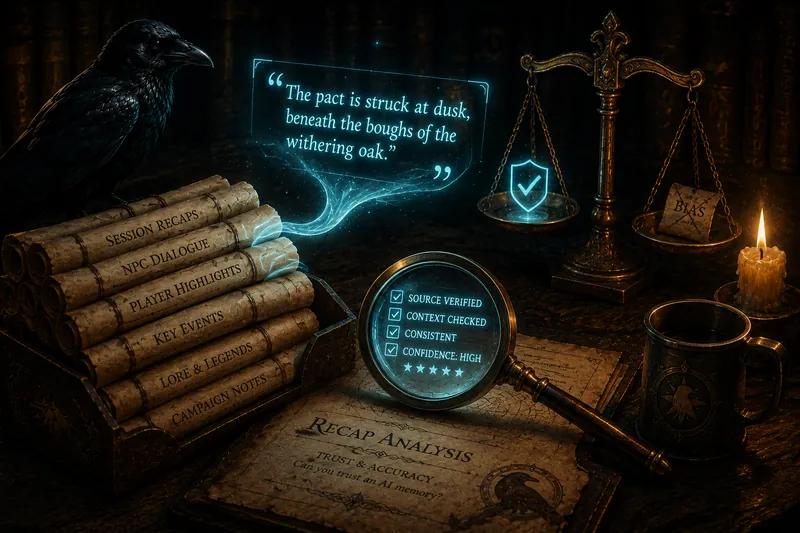
The honest catch with any AI-backed answer is grounding. An answer is only trustworthy if it is tied to what was actually said at the table, with a citation you can check, rather than a confident guess. Treat it as a fast, cited assistant that is usually right, not an oracle you never verify.
Recap Raven’s Memory plans are built around this idea. It is a Discord bot that records a session (your own bot or a Craig recording link), transcribes it per speaker, and builds a searchable campaign memory from your saved transcripts and recaps. You ask a question and get an answer quoted from the transcript with citations. It also produces a player-safe recap to share with the table after the game and GM-only notes that keep your secrets out of player view. Players can ask their own questions with /ask and /askprivate, and replies stay spoiler-safe and cited. It is in beta; Memory plans build Campaign World and keep it current as you play, while the GM can edit anything that needs correcting and answers stay grounded in what was recorded.

Stop being your campaign’s search engine. Choose a Memory plan to build campaign memory you can ask. Free Tier includes 5 Standard sessions in your first 30 days, then 1 every 30 days; campaign memory is not included.
Invite the Discord botFrequently asked questions
I already keep a recap doc. Is that enough?
For most tables, yes, as long as you keep it current and name things consistently. It starts to creak when you need a specific fact across many sessions and end up scrolling. That is where Recap Raven helps: it turns your recorded sessions into a memory you ask in plain language and get a cited answer from, so you stop being the search engine. A maintained doc is still a solid foundation.
How do I stop a recap from becoming a chore?
Keep it short and write it while the session is fresh. Better, record your sessions and let Recap Raven draft the player-safe recap for you, so you are reviewing rather than writing from scratch. A few bullets covering what changed, who they met, and any promises is enough if you are doing it by hand.
Can I trust an AI answer about my own campaign?
Only when it is grounded in what was actually said and shows you the citation. Recap Raven quotes the transcript behind every answer and abstains when the evidence is not there, so it is quick to verify and does not invent. Treat it as a cited assistant that is usually right, not an oracle, and check the quote when a ruling depends on it.
How do I keep player-facing recaps from leaking my secrets?
Keep GM-only notes apart from anything players can see. Recap Raven generates the player recap separately, keeps GM-only fields outside its generator, and posts the recap to your table through Discord. You can correct its share page afterward in the web portal.
If you would rather ask your campaign a question than scroll your notes, Recap Raven is one option that builds a searchable, cited memory from your recorded sessions.
Free Tier includes 5 Standard sessions in your first 30 days, then 1 every 30 days, each up to 3 hours long, with best-effort multilingual support. A title, short summary and scenes, with basic AI models and standard transcription quality. Premium adds richer recaps, PDF exports and GM insights; Memory plans add campaign Ask.