Trust and accuracy
Can you trust an AI to remember your D&D campaign?
Tools that promise to remember your campaign are everywhere now. The real question is whether you can trust the answer when it matters: a player asks who they swore an oath to, and you're about to make a ruling on it. A confident answer that turns out wrong is worse than no answer, because it rewrites your canon and you find out too late.
I built Recap Raven because I'm a DM and I needed a memory I could rely on at the table. I tried other tools and kept hitting answers I couldn't check, or that were quietly wrong. Here is what I learned about what makes a campaign memory worth trusting.
When the table remembers it differently
Here is the moment that makes this matter. You make a ruling, and a player is certain it went another way. They swear the baron promised them the land, you remember it as a maybe, and the table stalls while you relitigate a conversation from two months ago. Nobody enjoys that, and however you call it, someone can walk away feeling the game cheated them.
With a recorded campaign you can settle it in seconds, in front of everyone. Ask the question in Discord at the table, and Recap Raven shows the actual line from the session, quoted from the transcript. The disagreement ends because the record is right there, not because you pulled rank. A player seeing the real quote and nodding is the kind of trust I could not find in any other tool, and it is a big part of why I built this one.
Why a generic AI summary goes wrong
The common approach is simple: take the whole session transcript, hand it to a chatbot, and ask for a summary or an answer. It holds up until it does not. A long campaign is far more text than an AI can read at once, so details fall out, and when it cannot find something it tends to fill the gap with a confident guess rather than admit the gap.
The result is canon you cannot trust. Two sessions blur together, a name comes back slightly wrong, an event that never happened gets stated as fact. The deeper problem is that you cannot check any of it, because the answer points to nothing. You either take it on faith or dig through the transcript yourself, which is the work you were trying to avoid.
Cite the source, every time
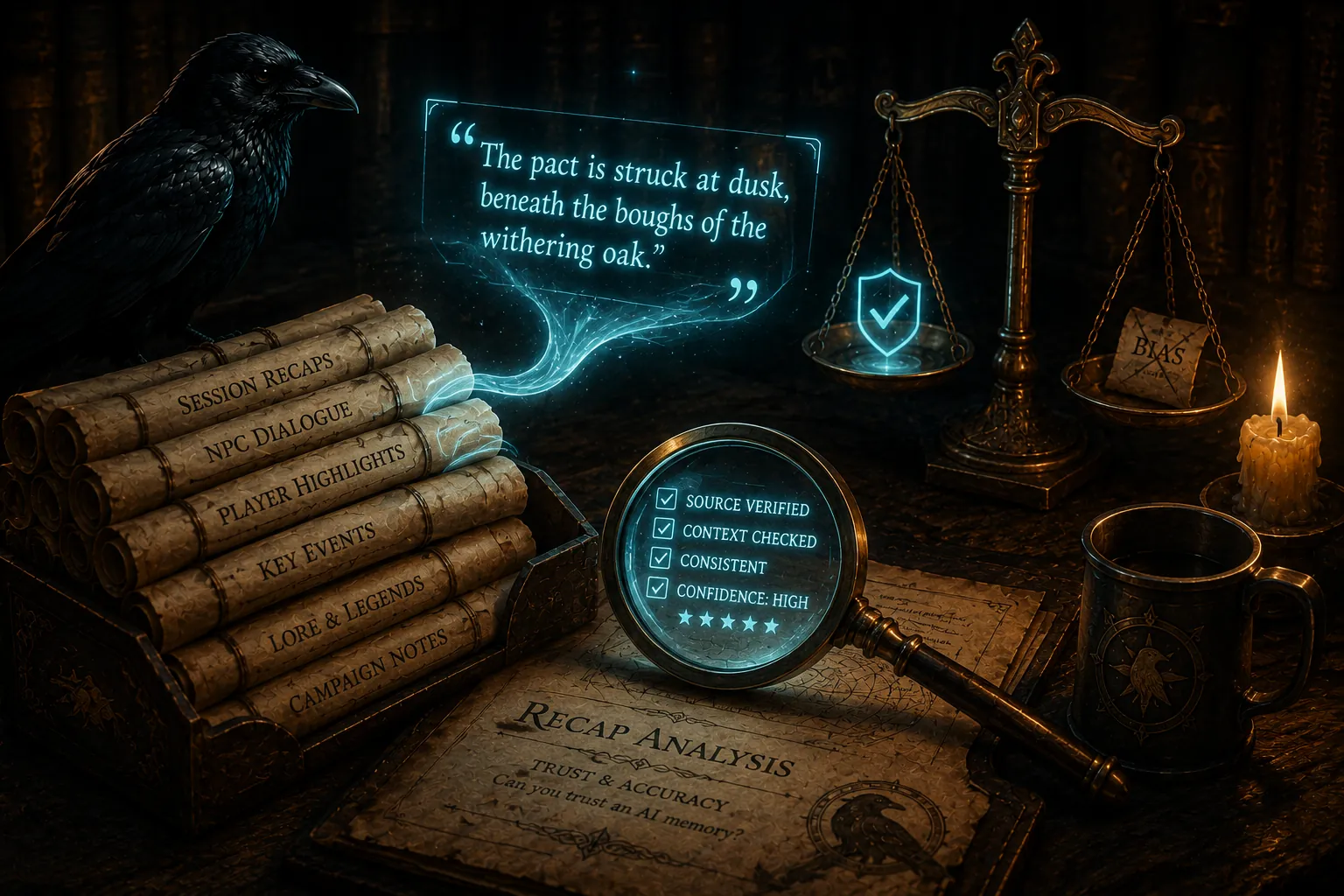
The most important property of a memory you can trust is that every answer shows its source. Recap Raven quotes the actual transcript behind each answer, so you can open it and read the line for yourself. When a ruling hangs on a detail, that thirty-second check is the difference between guessing and knowing.
Citations also keep you honest about what the tool is. Treat it as a cited assistant that is usually right, and verify when it counts. The quote is there precisely so you can confirm it and move on, instead of wondering whether the answer was real.
QUESTION: Who did the party promise the reclaimed deed to?

A GENERIC CHATBOT:
"The party promised the deed to Toben the merchant."
(No source. It sounds plausible, and it never happened.)

A CITED ANSWER:
"The party promised the deed to Maelis, in exchange for her
testimony against the guild."
Source, Session 12: "Fine. The deed is yours once you speak
to the magistrate."
(Open the quote, check the line, move on.)

AN HONEST ABSTENTION:
"I could not find a promise about the deed in the recorded
sessions."
(No invention, so a fact that was never true stays out of
your canon.)
Knowing when it does not know
A memory you can trust has to be willing to come up empty. Recap Raven abstains when the transcript does not support an answer, rather than inventing one. That sounds minor, and it is the thing that protects your canon. A tool that always answers will answer even when it is wrong, and you carry that error into the next session.
Saying nothing when there is nothing to say is a feature worth looking for. It tells you to go check, or to make the call yourself, instead of quietly handing you a fact that was never true.
Every answer comes with a confidence band
On top of the citation, every answer comes with a confidence band: high, medium, or low. It is derived from how well the transcript actually backs the answer, not the AI rating its own certainty, which is the one number you cannot trust it to give you honestly. A high band means the evidence is solid. A low band is your cue to open the quote and check, or to make the call yourself.
Taken together, the citation, the abstention, and the confidence band tell you how much weight to put on any answer at a glance. You are never left guessing whether the tool is sure of itself or bluffing.
How Recap Raven builds the memory
Under the hood, Recap Raven does more than forward your transcript to a chatbot. It builds a memory: it finds the relevant moments across your whole campaign, ranks them, and answers from those, with the quotes attached. That retrieval work is where the accuracy comes from, and it is why a question about session three still finds the right answer thirty sessions later.
I spent real engineering effort there on purpose, because a summary you cannot trust is not worth having at the table. Player-safe recaps and GM-only notes stay separate as well, so checking your canon never leaks a secret to the players.
No tool is perfect, so build for checking
None of this makes the answers perfect. AI gets things wrong, and Recap Raven will too. The point is to build for that reality: cite everything, band each answer by how well the evidence backs it, admit uncertainty, and keep the source one click away, so a wrong answer is easy to catch instead of quietly believed.
That is the standard I wanted as a DM, and the one I hold the tool to. I needed a campaign memory I could run a real game from, where I can trust an answer because I can see exactly where it came from.
Frequently asked questions
Can I trust an AI answer about my own campaign?
Only when it shows you the source. A cited answer pulled from your transcript is quick to verify and usually right. Treat it as an assistant that points you to the evidence, and check the quote when a ruling depends on it.
What happens when the tool does not know?
Recap Raven abstains rather than guessing when the transcript does not support an answer. You are told there is nothing to back it up, instead of getting a confident invention, which keeps a wrong fact out of your canon.
How is this different from pasting my notes into a chatbot?
A chatbot summarises whatever you paste and cannot point back to a source, so errors stay invisible. Recap Raven retrieves the relevant moments from your whole campaign and cites the transcript for each answer, so you can check it. The retrieval and the citations are the difference.
Does it make things up?
Any AI can, which is why every answer is grounded in your transcript and shown with the quote, and why it abstains when the evidence is missing. That does not make it flawless, and it does make mistakes easy to catch.
Recap Raven was built by a DM who needed a campaign memory accurate enough to run a game from. Every answer cites the transcript, and it tells you when it does not know.
Free Tier includes 5 Standard sessions in your first 30 days, then 1 every 30 days, each up to 3 hours long, with best-effort multilingual support. A title, short summary and scenes, with basic AI models and standard transcription quality. Premium adds richer recaps, PDF exports and GM insights; Memory plans add campaign Ask.