Session prep
How to prep your next D&D session (NPCs, handouts, and reading the party)
Good session prep comes down to writing the few things that make the table move: the NPCs your players actually talk to, the handouts they can hold, and a read on where they're headed next so you don't burn an evening detailing a town they'll skip.
Here is a practical way to prep that stays fast and holds up at the table, plus a couple of places a tool can save you the fiddly parts.
Prep NPCs by what they want
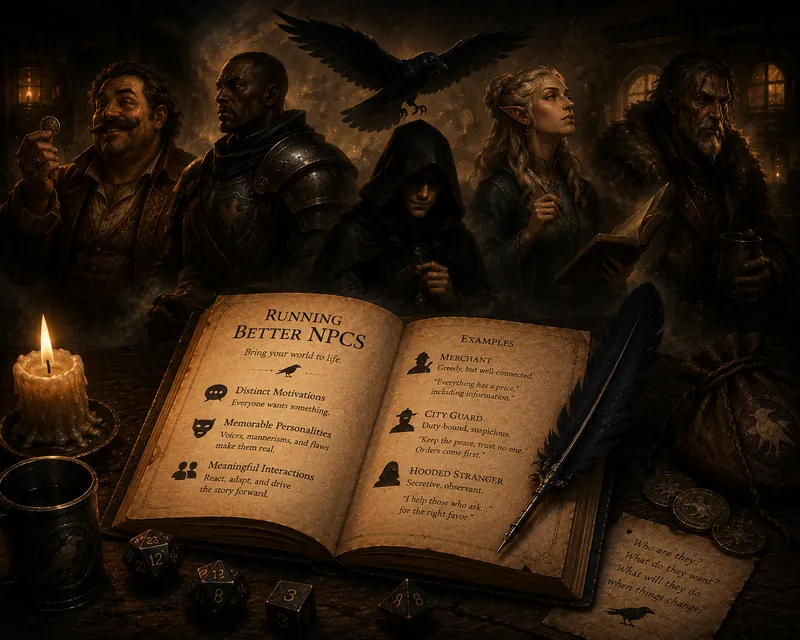
The biggest upgrade to your NPCs is a clear want. Give an NPC something to chase and they steer the scene on their own, and you stop having to push the conversation along. A voice or a quirk is a distant second.
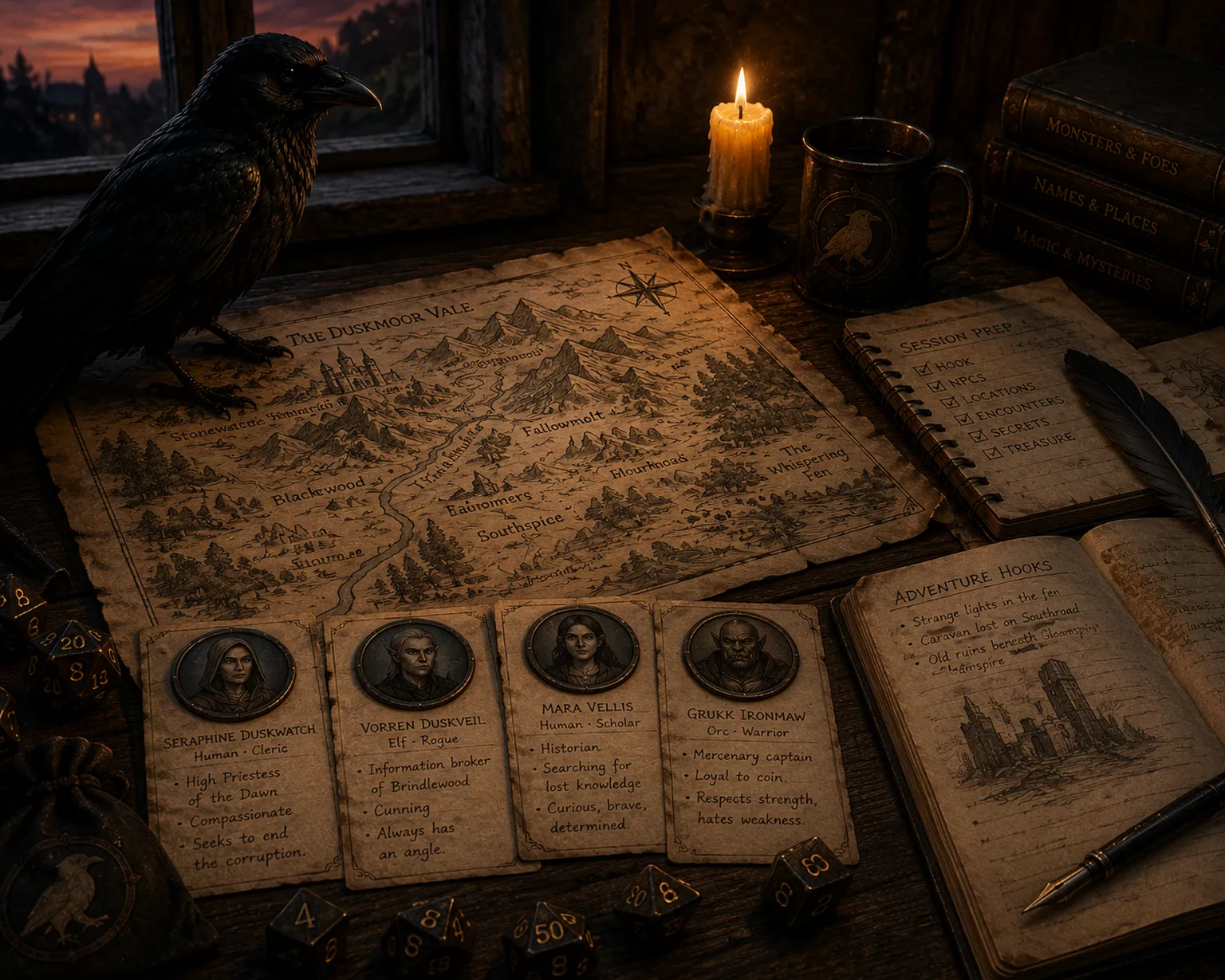
For every NPC who gets more than a passing line, jot down a few things: their goal, what they were doing right before the party walked in, what they want to do after, and one trait you can play. A small card like the one below is all you need, and it takes about a minute to make.
Take Maelis the harbour clerk. She wants the missing cargo manifest found before her boss notices. Right now she is hiding a discrepancy in the ledger. After this, she wants to be somewhere the party cannot ask follow-up questions, and she answers most questions with a question of her own.
That is enough to play her. When the party pushes, she has a reason to dodge, a reason to bargain, and somewhere she would rather be. The point is to give yourself just enough to scan at a glance, so you can improvise around her without breaking your world.
Decide what they'll share and what they'll hold
Once an NPC wants something, work out their price. Before the scene, jot a quick split: what they will give up freely or trade for, and what they will guard. This keeps you from either dumping everything or stonewalling by accident.
- Might share: a rumour about the docks, a name to chase, a warning to stay out of Greyford’s lower ward, a price for the favour, or a favour they need from the party first.
- Will hold back: who they answer to, the thing that gets them killed if it is known, and the lie they have already told someone else.
Read where the party is actually going
The fastest way to waste prep is to prep the whole map. Players only ever walk down a couple of roads in a given session, and they tell you which ones if you listen back.
Look at three signals from last session: the threads they chased, the questions they kept asking, and the people they care about. If they spent twenty minutes worrying about who sold out their contact in Greyford, that is your next session, not the dungeon you sketched two months ago.
Pick the two or three most likely directions and prep those properly. Leave the rest as a sentence each. You will cover more real ground with less work, and the table feels heard because the world responds to what they did.
This is one of the places a tool earns its keep. Recap Raven’s next-session prep reads your recent play and suggests likely directions, open threads to watch, and prompts drawn from what just happened, so you have a starting point instead of a blank page.
Minutes 0-5: reread last session’s recap. Note the threads the
  players chased and the questions they kept asking.
Minutes 5-10: pick the two or three directions they are most
  likely to take. One sentence each for everywhere else.
Minutes 10-20: NPC cards for anyone who will talk tonight:
  want, complication, what they share, what they hold back.
Minutes 20-25: one handout, map corner, or object the players
  can hold or picture.
Minutes 25-30: check what is already canon (names, promises,
  who knows what) so tonight does not contradict last month.
Check what is already canon before you invent
The other quiet prep-killer is contradicting yourself. You half-remember that the party owes Maelis a favour, or that only the cleric knows about the forged seal, and if you guess wrong the players will catch it.
Before you invent, confirm the things you are unsure of: a name, a promise someone made, who actually knows a secret. A quick check keeps this session consistent with what really happened at the table.
If you record your sessions, Recap Raven builds a searchable campaign memory you can just ask. Type something like "is it canon that the party owes Maelis a favour?" and you get an answer quoted from the transcript with a citation. It is usually right rather than an oracle, so the citation lets you confirm the source before you lean on it. It also keeps player-safe recaps and GM-only notes separate, so secrets stay on your side of the screen.
You can do this mid-game too. When a detail comes up and you are not sure, ask the campaign right there instead of flipping through sheets of paper, and you get an accurate answer in seconds. You can ask quietly just for yourself or out loud for the whole table, whichever suits your style, so "give me five minutes to look this up" turns into a game that keeps flowing and players enjoy more.
Players can ask too, any hour of the day, straight from Discord, and the answers stay spoiler-safe so none of your private lore or planned reveals slip out. That tends to mean fewer one-off questions landing in your messages during a busy week. If you would rather keep the lookups to yourself, you can turn player access off and let it look like you simply remember everything.
Frequently asked questions
How long should I spend prepping a session?
Ideally very little, because Recap Raven does the heavy lifting: it reads your recent sessions and hands you the likely directions, the open threads, and prompts to build on, so you start from a draft instead of a blank page. If you are prepping by hand, keep it to about thirty minutes: the two or three directions the party is likely to take, a handful of NPC cards, and any handout they will touch. A focused half hour beats a scattered three.
What if my players go somewhere I did not prep at all?
Lean on your NPC wants and reuse them, since an NPC with a clear goal and a price works in almost any scene. To stay consistent on the fly, ask Recap Raven what is already canon mid-game and get a cited answer in seconds, so you improvise on top of what really happened instead of guessing.
How do I keep my campaign details straight across months of play?
Let Recap Raven hold them for you. It builds a searchable memory from your recorded sessions, so instead of trusting your notes you ask what is canon and get an answer quoted from the transcript. Promises, debts, and who knows which secret are all one question away.
Are quick NPC cards really enough?
For most NPCs, yes: a want, a goal, what they were doing before and after, and one trait give you everything you need to play a scene. Recap Raven keeps the recurring ones straight, since you can ask what an NPC said or did in past sessions before you bring them back, so save the detailed backstories for characters who have earned the page.
Prep the NPCs and handouts by hand, and if reading the party and checking your own canon is the part that slows you down, Recap Raven is one option that handles both from your recorded sessions.
Free Tier includes 5 Standard sessions in your first 30 days, then 1 every 30 days, each up to 3 hours long, with best-effort multilingual support. A title, short summary and scenes, with basic AI models and standard transcription quality. Premium adds richer recaps, PDF exports and GM insights; Memory plans add campaign Ask.