Running the game
How to run better NPCs in D&D
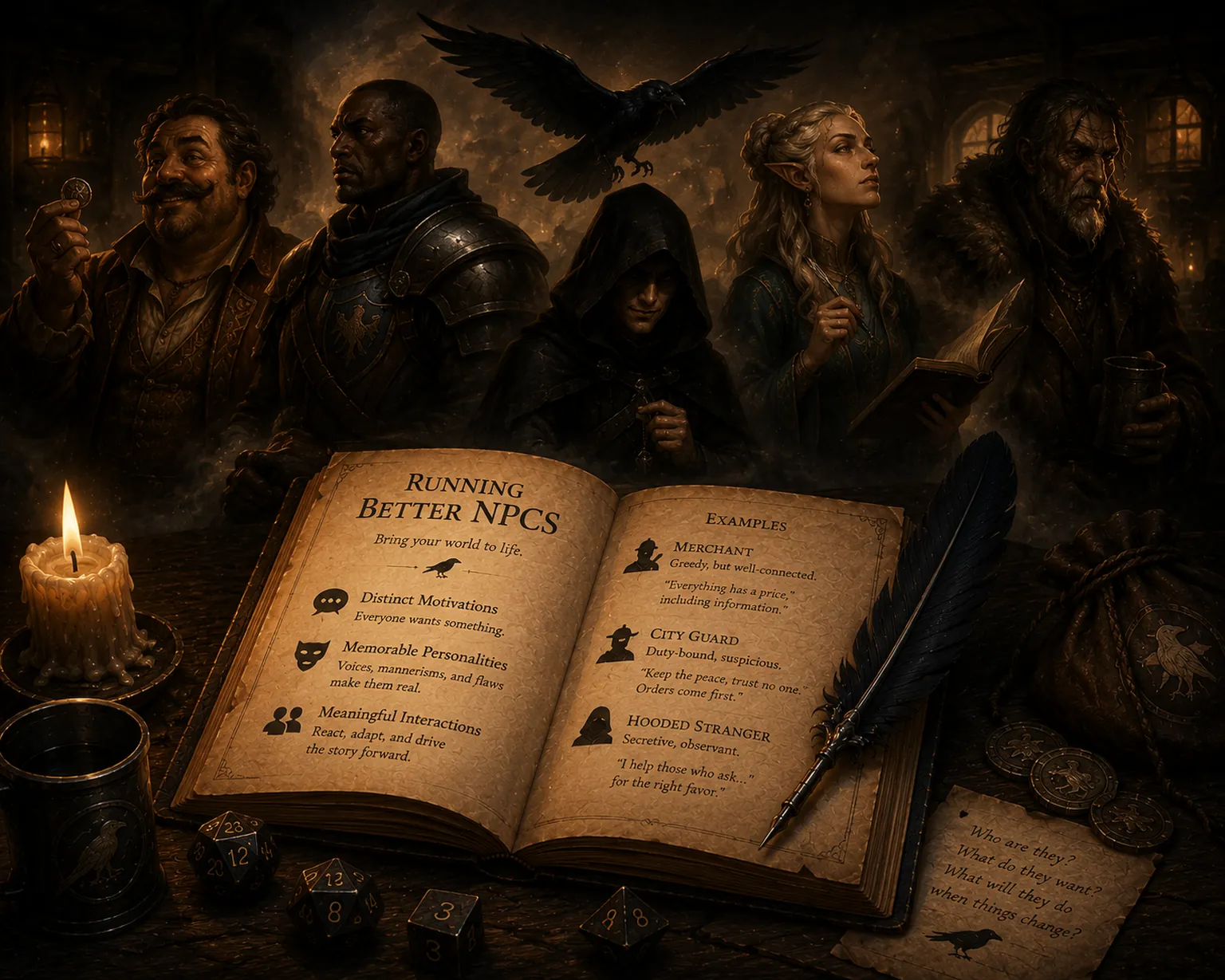
Most of the work of running an NPC happens before the dice come out. A character with a clear want and one thing getting in the way will make decisions at the table on their own, which means you stop improvising every line and start reacting to a person.
This guide covers the small moves that make NPCs feel real: giving each one a want and a flaw, fast voice tricks, deciding what they know versus what they'll say, and bringing characters back so your world remembers itself.
Give every NPC one want and one complication
The fastest way to make an NPC playable is to write down one thing they want and one thing in their way. Toben the merchant wants to clear his debt before the harvest festival, but he owes the wrong people and cannot be seen dealing with adventurers in daylight. That is enough. Now when the party walks in, Toben already has an agenda, and you are playing his choices instead of waiting for the players to prompt you.
The complication is what keeps them from just handing over what the party wants. It creates friction without you having to fake reluctance. A guard who wants to go home to a sick child will wave the party through for the wrong reason. A priest who wants to protect the town will lie to keep the peace. The want pushes them forward, the flaw bends them sideways, and the scene writes itself.
- Want: the thing they are trying to get in this scene or this arc.
- Complication: a debt, a fear, a loyalty, or a secret that stops them taking the direct route.
- If you only have time for one NPC note, make it these two lines.
NAME: Toben, harbour merchant
WANT: clear his debt before the harvest festival
COMPLICATION: owes the wrong people; cannot be seen dealing
  with adventurers in daylight
DOING RIGHT NOW: arguing with a creditor’s runner
WANTS AFTER THIS: to be anywhere the party is not
TRAIT: taps the counter when he is lying
WILL SHARE: dock rumours, a name, a price
WILL HOLD BACK: who he owes, and the lie he told his sister
Voice and mannerism shortcuts that actually hold up
You do not need a full accent. A single distinctive trait does more work and you can keep it consistent for an hour without your jaw aching. Pick one thing: Maelis always answers a question with a question, Toben taps the counter when he is lying, the captain refers to everyone by their job instead of their name. That one tag is what the players will remember and what tells them who is talking.
Posture and pace are even cheaper. Lean back and speak slowly for someone in control; sit forward and clip your words for someone nervous. If you want a verbal tic, keep it short so it survives a long session. The goal is recognisable, not theatrical. A trait you can repeat beats an accent you will drop by the second scene.
What they know versus what they'll tell you
Separate two things for any NPC who holds information: what they actually know, and what they will volunteer. Maelis might know the bridge is trapped, who set it, and why, but she will only mention the trap unless the party gives her a reason to say more. The gap between those two is where roleplay lives.
Decide upfront what it costs to get the rest. Money, a favour, a promise, proof the party can be trusted, or just patience. When a player pushes, you already know the price, so you are not inventing reluctance on the spot. This also keeps you honest: if an NPC has no reason to hold back, let them talk and save the tension for someone who does.
Bring NPCs back so the world feels alive
A world feels real when people return. The minor shopkeeper the party tipped well, the guard they spared, the kid they scared in Greyford, all of them are free callbacks. Reincorporating a character the table already liked gets a bigger reaction than any new NPC you could introduce, and it costs you nothing to prep.
Let NPCs remember what the party did to them, good and bad. If they stiffed Toben last month, he charges more or sends them to a rival. If they saved Maelis, she takes a risk for them later. These small consequences make choices feel weighted, because the players learn the world keeps score. You do not need a grand reckoning, just a line that shows the character remembers.
The same goes for the threads the party leaves dangling. An NPC you introduced five sessions ago, a captured child the party never went back for, a quest reward they forgot to collect: those are open hooks, and a living world does not freeze them in place. Maybe someone else rescued the children and now wants paying, or the reward quietly went to a rival. Bring it back through an NPC and the world keeps turning whether the party acted or not. Recap Raven helps here by tracking which hooks are going stale, so you get a nudge to move one on and let the consequences land in a later session, which keeps players invested in a world that remembers what they did and did not do.
Keep NPCs consistent across a long campaign
The quiet failure mode in a long game is contradicting yourself. You rename Toben halfway through, forget that Maelis already told the party about the bridge, or give a recurring NPC a different motive than last season. Players notice, and it punctures the world faster than any bad voice.
A few habits help: keep a running one-line note per recurring NPC, write down anything they told the party out loud, and check it before they reappear. If you run sessions on Discord, Recap Raven records and transcribes each session and builds a searchable campaign memory you can ask, so before you bring Maelis back you can ask what she told the party about the bridge and get an answer cited from the actual transcript. The recap and GM notes also log NPC appearances, which makes it harder to contradict yourself three months later. It is one option among many; a tidy notebook does the same job if you keep it current.
Before a recurring NPC walks back on stage, run through a few memory questions. They take a minute to answer from your notes (or one question each to a searchable memory) and they catch most contradictions before the players do.
- What did they tell the party out loud, and in which session?
- What did the party do to them (helped, robbed, embarrassed), and would they remember it?
- What did they promise or threaten, and has it come due?
- What do they still want, and did the party change the odds of getting it?
- Who else do they know that the party has since met?
Frequently asked questions
How do I roleplay an NPC when I'm not a good actor?
Skip the acting and lean on one clear trait plus a clear want. If players know Toben taps the counter when he lies and that he is desperate for cash, the scene plays itself without a performance. To keep a recurring character consistent, Recap Raven lets you check what they said or did in past sessions, so the same NPC keeps the same voice without you memorising everything.
How much should I prep for a single NPC?
Two lines is enough for most: one want and one complication. Add a single voice tag if they will talk for a while, and a note on what they know versus what they will reveal. For recurring NPCs, Searchable Memory does the remembering, so you can ask what they told the party last time instead of re-prepping their whole history.
How do I stop my NPCs from just handing the party everything?
Decide in advance what it costs to get information out of them. Give the NPC a reason to hold back, whether money, a favour, trust, or fear, and name the price before the scene. Searchable Memory helps you keep track of what an NPC has already told the party, so you do not accidentally hand over something you meant to keep behind the screen.
How do I keep a recurring NPC consistent over months of play?
Keep a one-line note per recurring NPC and write down anything they said to the party out loud, then check it before they return. The common mistakes are renaming them or forgetting what they already revealed. Searchable Memory does this from your recorded sessions: ask what an NPC said before you bring them back and get a cited answer from the transcript, so the character stays consistent without a manual log.
If you run your table on Discord and want to ask what an NPC said in a past session before you bring them back, Recap Raven’s Memory plans keep a cited, searchable record of your game.
Free Tier includes 5 Standard sessions in your first 30 days, then 1 every 30 days, each up to 3 hours long, with best-effort multilingual support. A title, short summary and scenes, with basic AI models and standard transcription quality. Premium adds richer recaps, PDF exports and GM insights; Memory plans add campaign Ask.