Player-safe recaps
Player-safe recaps: share the story without spoiling your secrets
A recap is one of the best tools you have for keeping a campaign alive between sessions. It reminds everyone what happened, who they met, and what they were about to do. The trouble is that a full recap, the kind you would write from your own notes, often contains things your players' characters have no idea about: the villain's actual plan, who the traitor really is, the twist you have been seeding for six weeks.
A player-safe recap fixes that. It retells the session from the players' side of the table and leaves your secrets where they belong. Here is how to think about it, a checklist for what stays out, and how to write one by hand so nothing slips through.
Why a full recap can spoil your game
When you write a recap straight from your prep and your memory, you know everything. You know the Ashen Magus is funding the merchant guild. You know Maelis lied about where she was that night. So the recap you would naturally write quietly assumes all of that, and a single sentence can hand the table a reveal you were saving for three sessions out.
The fix is a shift in point of view. The players only experienced part of the session, the part their characters saw, heard, and decided. A player-safe recap is that experience retold, with everything they did not learn taken back out.
What to keep OUT of a player recap
These are the things that read as spoilers because the characters do not know them yet. If it lives behind your screen, it stays behind your screen.
- Your intentions: why an encounter happened, what it was meant to set up, where the plot is going.
- Unrevealed NPC motives: what Maelis actually wants, who she really works for.
- Hidden identities: the traitor at the table, the noble who is secretly the Ashen Magus.
- Foreshadowing you planted: the omen, the recurring symbol, the line the players did not clock.
- Mechanical and behind-the-screen info: DCs, hit points, which roll nearly killed someone, what was a trap.
- Plans for next session: the ambush waiting in Greyford, the betrayal you have scheduled.
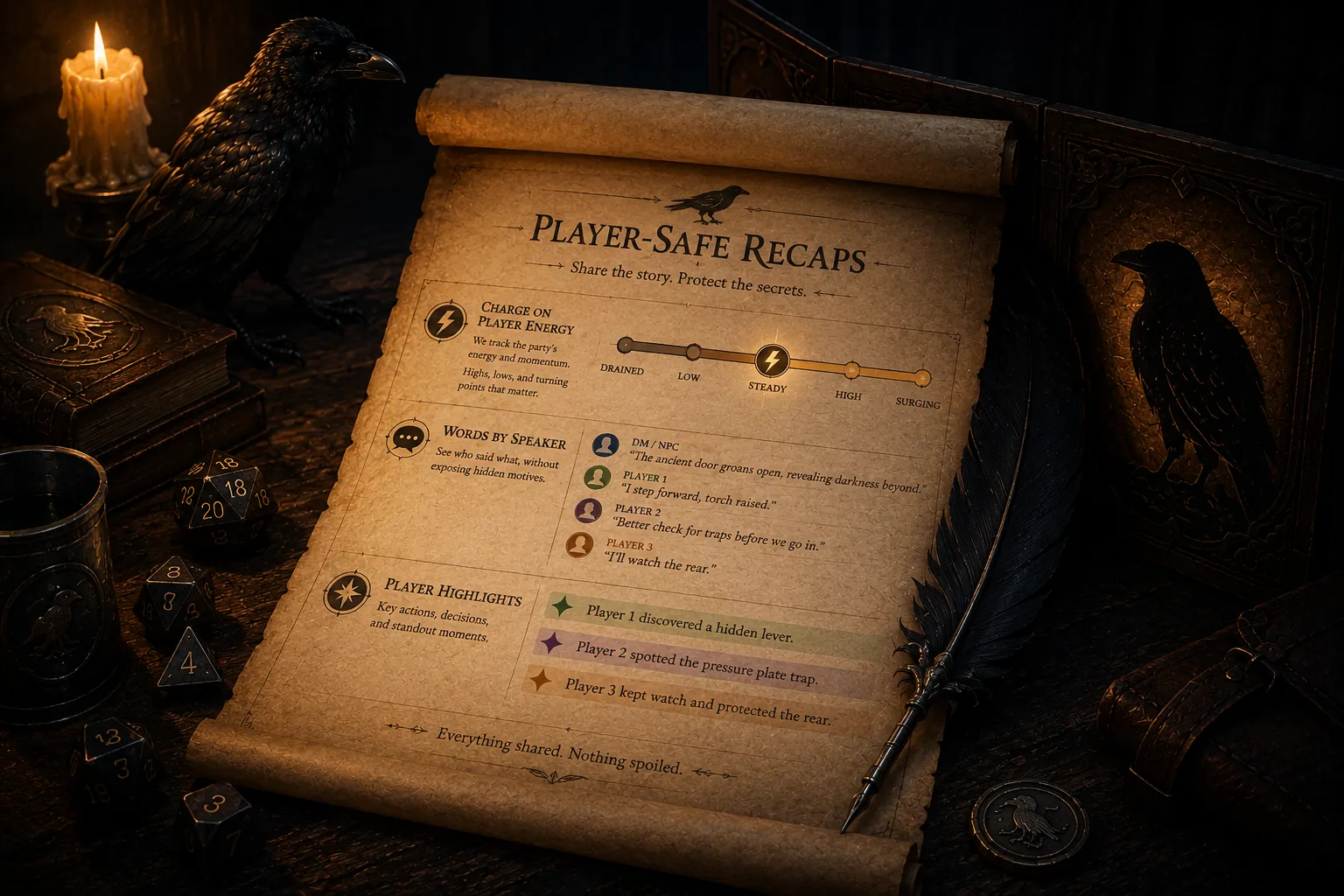
Watch out for tools that let an AI connect dots your players have not. You dropped the hints and the AI has worked out the twist, but the table has not, and that inference does not belong in a player recap. Recap Raven only reveals what the players have actually established they know, so it cannot spoil a reveal you are still building.
What's fine to keep IN
The safe material is everything the party actually experienced. If a character saw it, said it, or chose it, you can retell it.
That usually covers more than you would expect, and it is the stuff players actually want to be reminded of before the next game.
- What the party did: the fight in the market, the climb up to the old keep, the deal they struck.
- Who they met and talked to: NPCs by name once the table has met them face to face.
- What they decided: the plan they argued over, the path they chose, the offer they refused.
- Where they ended up: the cliffhanger, the town gate, the door they were about to open.
UNSAFE (written from behind the screen):
"The party met Maelis, who is secretly working for the Ashen
Magus and lied about the missing manifest to cover the guild’s
smuggling run."

PLAYER-SAFE (what the table actually saw):
"The party met Maelis, a harbour clerk who seemed nervous about
a missing cargo manifest and dodged most of their questions."

The unsafe version leaks her employer, her lie, and the smuggling
plot. The safe version keeps every observable fact and none of
the secrets.
Keep your notes light, and let the structure do the work
Plenty of DMs start a wiki, then realise around session fifteen that keeping it current, with every cross-reference and backlink, has quietly become a second job. Obsidian is popular for the same reason, and it is still upkeep. DMs are players too, and the admin around a game should not weigh more than the game itself. You need just enough to run a good session and keep the campaign on track, and less is usually more when it has the right focus.
What helps is structure rather than volume. Group what you keep by the things you actually reach for at the table: locations, NPCs, and open hooks. Recap Raven organises your campaign that way for you, so you can pull up a place or a person without scrolling a wall of notes, and your player-safe recap stays separate from your GM-only notes so nothing leaks to the table.
It also keeps your threads honest. After each session Recap Raven checks which hooks the party closed and which new ones opened, so the loose ends you meant to chase do not vanish between games.
Frequently asked questions
How do I share a D&D recap without spoiling my players?
Write it from the players’ point of view and include only what their characters saw, heard, and decided, then read it back and cut anything that reveals something only you know. Or let Recap Raven generate the player recap separately while keeping GM-only fields outside its generator. Either way, keep your secrets in separate GM-only notes.
What counts as a spoiler in a session recap?
Anything the characters have not learned yet: a villain’s real plan, a hidden identity, an NPC’s true motive, foreshadowing the table missed, or your plans for next session, plus behind-the-screen mechanics like DCs and hit points. Recap Raven keeps these out by only surfacing what the players have actually established they know, so a reveal you are still building does not leak.
Can I just write one recap and trust myself to leave secrets out?
You can, but a single assumption baked into one sentence is easy to miss when you are writing for flow, which is why a deliberate read-back pass helps. The safer route is to let Recap Raven generate the player-safe recap and keep your GM-only notes separate, so the split is built in rather than something you police by hand every week.
Does an automated recap tool keep my secrets safe?
Recap Raven grounds its recaps in the session transcript and generates the player recap separately, with GM-only fields kept outside its generator and your secrets held in separate GM-only notes. It is built carefully because a leak is the worst-case mistake. No tool is perfect, so the GM can correct the share page afterward in the web portal.
If writing and checking a player-safe recap after every session is more than you want to do by hand, Recap Raven produces the player recap separately and keeps your GM-only notes outside its generator.
Free Tier includes 5 Standard sessions in your first 30 days, then 1 every 30 days, each up to 3 hours long, with best-effort multilingual support. A title, short summary and scenes, with basic AI models and standard transcription quality. Premium adds richer recaps, PDF exports and GM insights; Memory plans add campaign Ask.