From my own table
My players told me I talk too much as a DM. So I measured it.
Across anonymised sessions from other Recap Raven campaigns, the DM accounted for 48% of the words spoken on average. Across the ten sessions I measured while acting on my players’ feedback, my own average was 38.5%.
I have played D&D for years, but I am still relatively new to being the person behind the screen. I am running a published campaign for friends I have played with for a long time, including the DM from the game I play in on Mondays.
About ten weeks ago, the group told me: "You talk too much. You should try being quieter."
I work in engineering leadership, so my response was predictable: let’s measure and track it.
There is a lot happening behind the screen
As a player, I have one character to think about. As the DM, I have the NPC speaking, the scene around them, the rules question somebody just asked, what the players know, what they do not know, what I planned, what they did instead, and whether the other half of the party is bored because the group has split up again.
My group likes splitting the party. They normally manage it once a session.
During a session I was too busy running the game to judge whether I was leaving enough room for everyone else. Afterwards I could ask my friends whether I was being a good DM, but few people want Friday night D&D to end with a performance review.
So, was I actually talking too much?
Recap Raven records our Discord session with everyone’s consent, transcribes it by speaker, and gives me the notes afterwards. That let me track how much of the conversation was mine.
Across the ten full sessions following the feedback, my share averaged 38.5%. It started at 38.0% and finished at 38.5%, with no clear upward or downward trend.
The individual sessions ranged from 33.6% at the low end to 48.5% at the high end. The graph uses the actual campaign session numbers, Sessions 7 through 16.
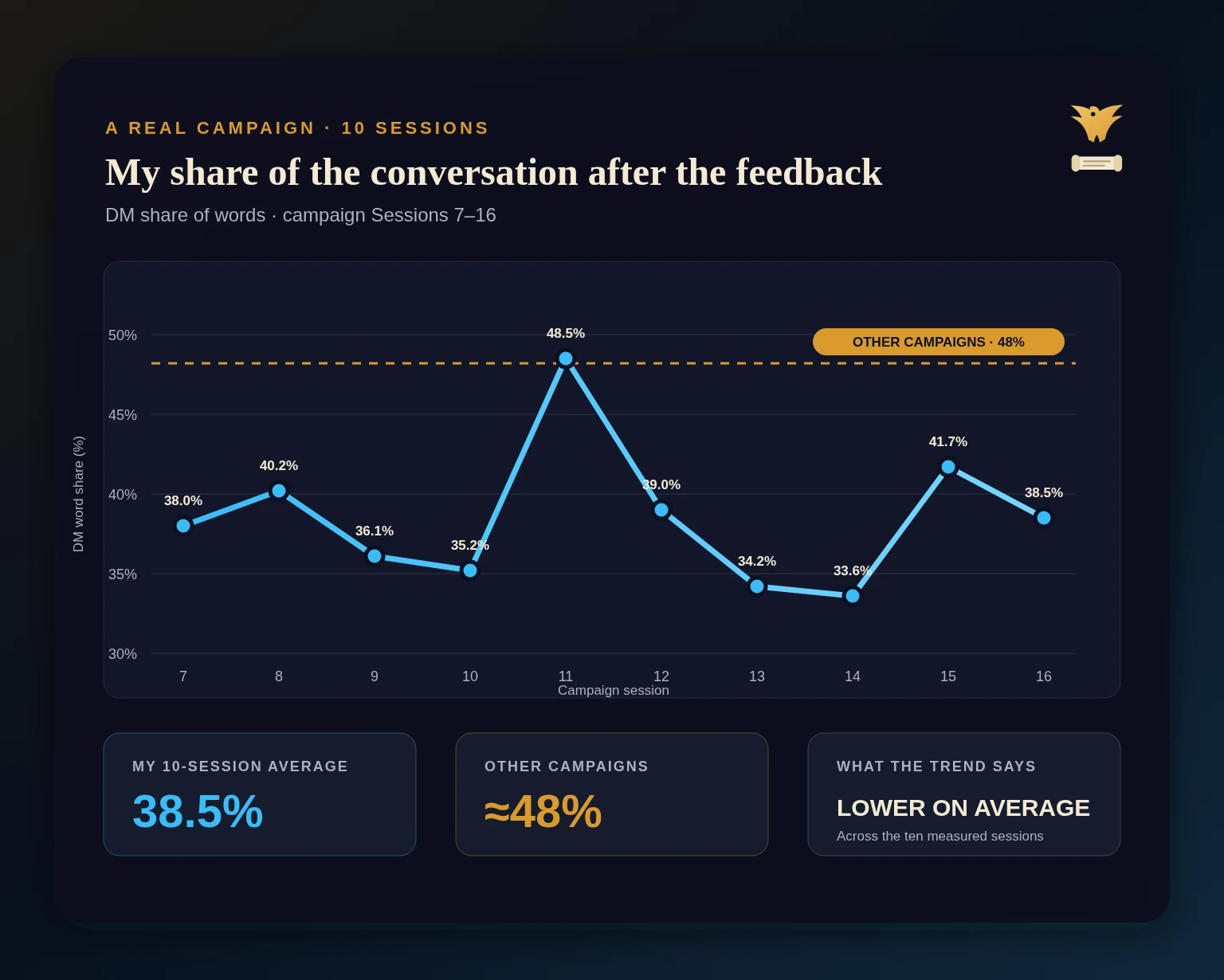
The jump in Session 11 was the night the party attacked someone in the town square unprovoked. The guards turned up and the party ran off in five different directions. I got excited trying to keep up with everyone, and talked much more than usual.
How much does a DM usually talk in a D&D session?
Knowing that I spoke 38.5% of the words was useful, but I had no idea whether that was normal. I needed something to compare it with.
There are plenty of reasons for that figure to move. Party size matters. A combat-heavy session has a different rhythm from four hours of social play. The DM describes the world, speaks for every NPC, explains rulings, and moves scenes along.
Words and speaking time are different measures, too. Neither one tells you whether somebody is a good DM. My 38.5% average is about ten percentage points below the session average from other campaigns. That gives me context for the feedback, but it cannot tell me whether I leave space at the moments when my players actually want it.
What the table energy showed me
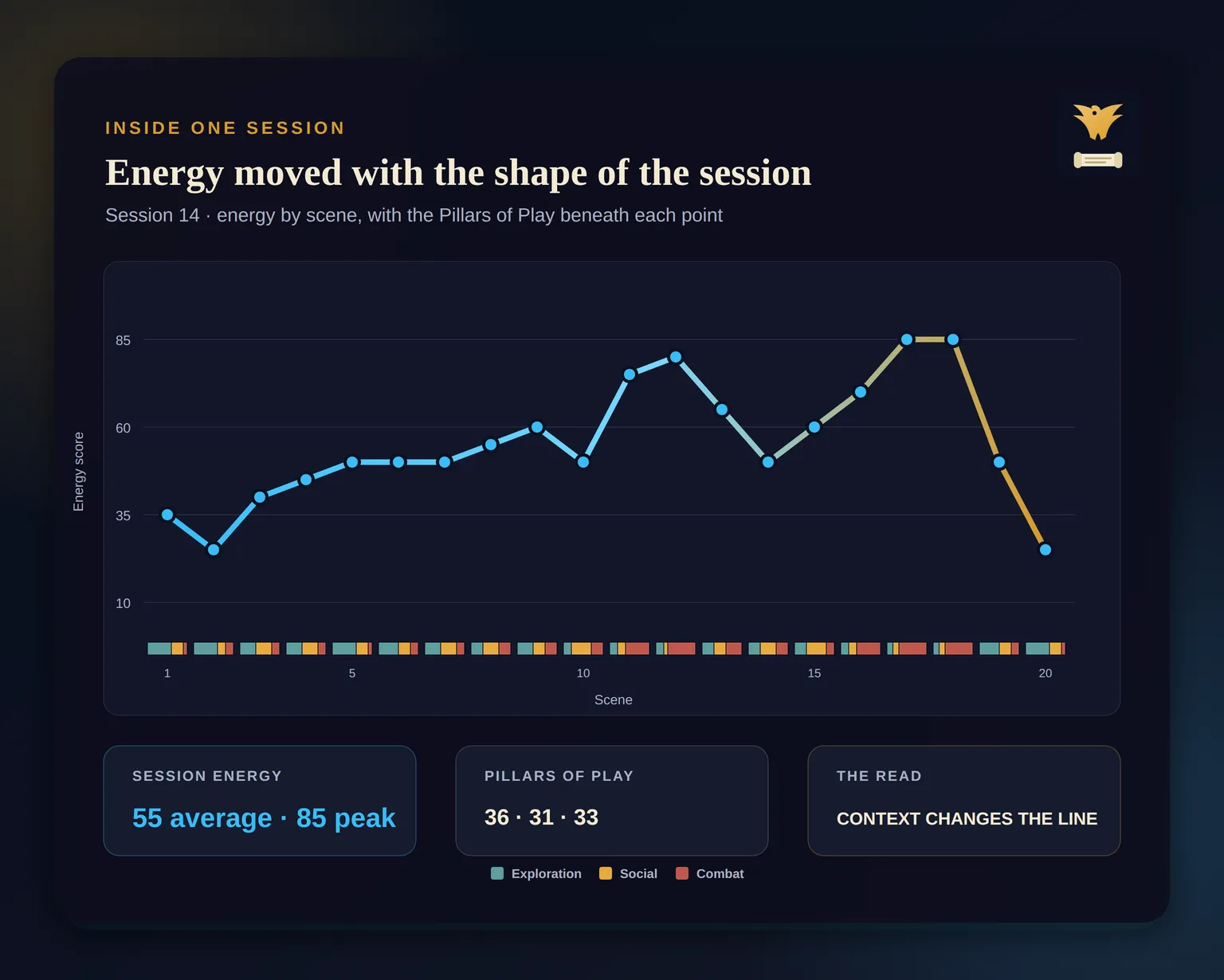
Recap Raven splits each session into scenes and estimates how the table energy changes through the game. The graph below follows Session 14 scene by scene. Its energy moved from 25% to 85% as the mix of exploration, social play, and combat changed.
That does not give me a clean answer about how much I should talk. A quieter exploration scene and a climactic fight ask different things from the DM, even when both are working well for the table.
That makes sense when I look at what happened. Sometimes I am talking because I have failed to leave space for the players. Sometimes an NPC conversation has everybody focused. Sometimes I am describing something the party has worked towards for three sessions.
The bars beneath the line show whether we were exploring, roleplaying, or fighting in each scene. I can see what the table was doing when the energy changed, then go back to what actually happened in the session.
What I took away from the analysis
The useful lesson was not that I had found the right percentage. My share moved by nearly fifteen percentage points between sessions. Looking back at what happened in each one told me far more than the average on its own.
I have also become happier letting a pause feel slightly uncomfortable. Instead of jumping in straight away, I wait and give the players room to respond through their characters. I only step back in when the scene actually needs moving on.
I also notice long NPC explanations sooner. When an NPC has a lot of information, I give the players room to interrupt, ask questions, or steer the conversation instead of delivering everything in one block.
Want to see who has the spotlight at your table? Try session stats in your free premium welcome sessions. Free Tier includes 5 Standard sessions in your first 30 days, then 1 every 30 days; advanced analytics require a paid plan. No card required.
Track your first session freeHow much should a DM talk?
I do not know, and I am increasingly suspicious of any universal percentage. One table could sit well above 50%, another well below it, and both could have a brilliant game.
What matters to me now is whether I make space when the players want it, whether everybody has opportunities to contribute, and whether I respond when the table gives me feedback.
Ten weeks ago I was told to be quieter. I changed how I leave pauses and deliver information. Across the ten sessions since, my average share has remained lower than the session average from other campaigns.
Whether I have become a better DM is still a question for the people playing with me.
Frequently asked questions
What percentage of a D&D session should the DM talk?
There is no useful universal target. Across anonymised sessions from other Recap Raven campaigns, the DM accounted for roughly 48% of the words on average, but party size and style of play can move that figure substantially. Your own pattern and your players’ feedback are more useful than chasing one percentage.
Does talking less make you a better DM?
Only when your talking is crowding out the players. A focused NPC exchange or a long-awaited reveal may need plenty of DM speech. Look for repeated long blocks, players struggling to enter a scene, and whether the same people keep losing space across several sessions.
How can a DM stop talking so much?
Leave a genuine pause after giving the players information, break long NPC explanations into pieces they can question, and stop narrating once the players have enough to act. Reviewing a transcript or speaker trend afterwards can show whether the change lasts.
Are word counts a reliable measure of table engagement?
Word counts reveal patterns, not quality. Compare them with talk time, turns, scene energy, and what actually happened in the game. Recap Raven keeps those measures together so a high or low percentage never has to stand on its own.
I built Recap Raven because I wanted to stop taking notes during the game and see patterns I would otherwise miss. It records Discord sessions with the table’s consent and produces player-safe recaps on a permanent Free Tier. Premium adds private session analytics and feedback, which you can try in your free welcome sessions. No card required.
Free Tier includes 5 Standard sessions in your first 30 days, then 1 every 30 days, each up to 3 hours long, with best-effort multilingual support. A title, short summary and scenes, with basic AI and standard transcription quality. Premium adds richer recaps, PDF exports and GM insights; Memory plans add campaign Ask.