From the session notes
The three pillars of D&D: what actually happens at the table?
Ask a DM what their campaign is mostly about and they will probably have an answer. Combat-heavy dungeon crawling. Political intrigue. The sort of campaign where the party spends forty minutes deciding what to do with a suspicious door.
That describes what the campaign feels like. I wanted to compare that impression with Recap Raven’s session analysis, then look at what a DM can usefully do with the results.
What are the three pillars of D&D?
The three pillars of D&D are exploration, social interaction and combat. They describe broad activities during an adventure, and a single encounter can involve all three.
Imagine the party arriving at a ruined watchtower. They inspect the damage, question a surviving guard and eventually fight whatever has taken up residence in the cellar. The investigation gives them clues; the guard helps them understand the danger. Even after the fight, they still need to decide what to do about it.
- Exploration: travelling, searching for clues, solving puzzles and testing how the environment works.
- Social interaction: bargaining, questioning, persuading and talking in character with NPCs or other party members.
- Combat: fighting enemies and resolving tactical encounters through the combat rules.
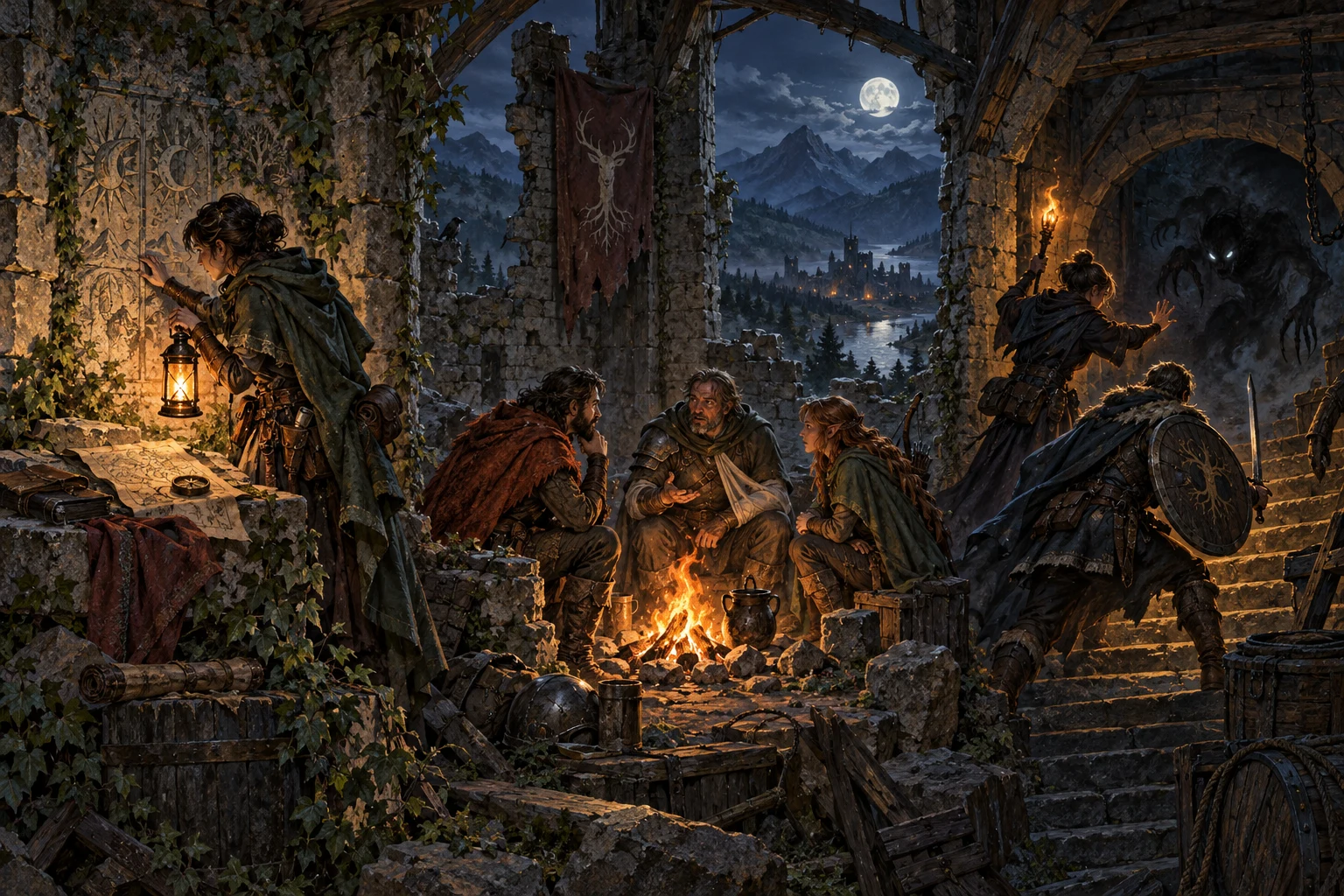
One location can give the party reasons to investigate, talk and fight. These are illustrative scenes, not examples drawn from a recorded campaign.
What our internal play mix showed
Recap Raven estimates the mix of exploration, social interaction and combat in session scenes. In the Table Insights figures used for this article, exploration had the largest share, followed by social interaction.
Together, exploration and social interaction accounted for 77% of that estimated mix. A fight can dominate how I remember a session, especially if somebody nearly dies. Looking at the surrounding scenes brings the investigation and conversations back into view.
| Pillar | Average play mix | Example activity |
|---|---|---|
| Exploration | 41% | Inspecting the watchtower for clues |
| Social interaction | 36% | Questioning the surviving guard |
| Combat | 23% | Fighting the creature in the cellar |
Visit TTRPG Table Insights for up-to-date statistics on exploration, social interaction and combat.
Does a campaign need equal amounts of each pillar?
No. A group that enjoys tactical encounters might happily spend half the evening on one dangerous fight. Another group might spend a whole session investigating a murder and leave eager to continue next week.
The useful question is whether the game matches what the players want. If you describe your campaign as political intrigue but spend most sessions fighting, ask whether that is a welcome development. Players who built their characters around negotiation may be waiting for a chance to use them.
You do not need to squeeze all three pillars into every session. A heist might take an evening to plan and another to carry out. Look across several games before changing your preparation.
Browse Campaign Showcase to see how the pillars of play differ between campaigns. Open a campaign with a Pillars of Play breakdown, then read its published recaps to see the adventures behind the percentages. You do not need an account to explore.
Exploration and social scenes are easy to underestimate
In my latest Rime of the Frostmaiden session, an antagonist left town to gather support. The party decided to take the opportunity to search his house. I had not prepared it. I was thinking about what he would do next; they wanted to know what he had left behind. Suddenly, an unprepared house was where the adventure was happening.
Social scenes leave a different sort of record. The party promises to protect someone, offends an ally or agrees to something without understanding the cost. There is no initiative tracker reminding you who made a promise three sessions ago.
Time alone tells you little about those consequences. Half an hour of tavern jokes and a thirty-second exchange that changes the party’s loyalties deserve different kinds of follow-up. Recap Raven Moments helps identify who shaped those story events: talking more does not automatically mean contributing more moments. Our Table Insights article explains how it works.
Roleplaying can happen during any pillar. A character who refuses to abandon an injured enemy is making a roleplaying choice during combat. Calling social interaction “roleplay” can make the other parts of the game sound less character-driven than they are.
See the pillars of play in a real campaign
Recap Raven’s session analytics bring the scene breakdowns together in a Pillars of Play bar. You can review the mix afterwards without keeping a stopwatch or another set of notes while you run the game.
The chart below comes from my Rime of the Frostmaiden campaign in the public Showcase. Social interaction has the largest share in this snapshot, with exploration close behind. Open the published recaps and you can see the sessions behind the chart.

My campaign’s public chart, captured on 10 October 2026. Displayed percentages are rounded. Explore the campaign and its recaps in Showcase.
Find D&D players who enjoy your style of game
How often has a potential player asked whether your game is combat-heavy or more about roleplay? Some people want tactical fights with less time spent talking. Others want character conversations, relationships and political intrigue. That is worth discussing before someone joins.
I like to explain what kind of GM I am, but my impression of a campaign only tells part of the story. With a Pillars of Play breakdown, alongside other Recap Raven analytics such as how much I speak, I can show how our sessions have actually unfolded. I have something to back up my description, and prospective players can judge whether it sounds like their kind of game.
Share your campaign through Showcase so prospective players can see the breakdown and read a few recaps. You can also mark it as looking for players and add your game listing links. The figures and the story together give people a clearer idea of the table they would be joining.
Use the results to prepare the next game
Ask something specific while everyone is packing up: “We spent most of tonight investigating. Would you enjoy more of that next time, or are you itching for a fight?” Give them room to disagree. The scene you worried was dragging might be the one they wanted to stay in.
If exploration keeps drawing the players in, spend some of your preparation on clues they can act on. Let a discovery change their options. If conversation carries the campaign, bring back an NPC who remembers what the party promised.
For a group that wants more combat, ask what they enjoy about a fight. Testing a character build, surviving a close encounter and defending someone they care about call for different preparation. A percentage cannot tell you which one they mean.
Sources and method
Sources checked on 10 October 2026.
- D&D Beyond: Playing the Game
- Recap Raven internal Average play mix dashboard snapshot, consulted 10 October 2026
Frequently asked questions
What are the three pillars of D&D?
Exploration, social interaction and combat. Exploring a ruin, questioning its caretaker and fighting an intruder can all happen in the same encounter.
How much combat should a D&D session have?
There is no universal percentage. Ask what your group enjoys and review several sessions together. The 23% combat figure in our internal play mix describes that analysis only; it is not a target or a percentage of total recorded time.
What counts as exploration in D&D?
Travel, searching rooms, examining objects, solving puzzles and investigating the environment can all count as exploration. It can take place inside a single building as readily as across a wilderness.
Is roleplay the same as social interaction?
Social interaction covers conversations and dealings between characters. Roleplaying is broader: choosing how your character acts can matter while exploring or fighting too.
Review your table’s play mix with Recap Raven’s advanced session analytics, available on paid plans and in the Premium + Memory welcome session.
Free Tier includes 5 Standard sessions in your first 30 days, then 1 every 30 days, each up to 3 hours long, with best-effort multilingual support. A title, short summary and scenes, with basic AI and standard transcription quality. Premium adds richer recaps, PDF exports and GM insights; Memory plans add campaign Ask.