Table Insights
D&D session length and combat time: how does your table compare?
You finish a session wondering whether you talked too much. Or combat seemed to take hours, and you are not sure whether that is normal. What happens at other tables? Unless you play in several groups, you may have little to compare your own game with.
We created TTRPG Table Insights to help answer those questions. Recap Raven sees how sessions unfold across different campaigns, and we share anonymous statistics that give the TTRPG community something useful to learn from together.
How long does a D&D session last?
A short game after work and a whole Saturday around the table can both suit the people playing. To understand what is typical, we look at the range of session lengths as well as the average. How common are shorter evenings, and how often do groups play for four hours or more?
Most of us know our own group much better than we know the wider hobby. A GM who describes every room in detail may wonder whether everyone else talks less. A party that spends an evening negotiating might assume other groups get through far more encounters.
Seeing a range of tables can put those impressions in perspective. Sometimes it will reassure you. Sometimes it will give you a reason to ask your players whether they would enjoy a change.
TTRPG Table Insights brings together session length, combat duration, conversation share and the pillars of play. It covers D&D and other tabletop RPGs played with Recap Raven.
How long does D&D combat take?
The party finally defeats the enemy, you look at the clock, and most of the evening has gone. Was that an unusually long fight? Or is that a familiar game night for groups playing this way?
An average alone will not answer that. Table Insights shows typical combat-scene lengths, how much they vary, and how often they run beyond an hour. Session length matters too: an hour of combat fills half a short evening, but a smaller part of an all-day game.
The system, party size and encounter all affect the comparison. A tense boss fight can hold everyone’s attention for ages; a much shorter encounter can drag if players spend it waiting for their turn.
The pillars of play also show how combat fits alongside exploration and social interaction. You might remember the big fight most clearly and still discover that investigating and talking occupied more of the session.
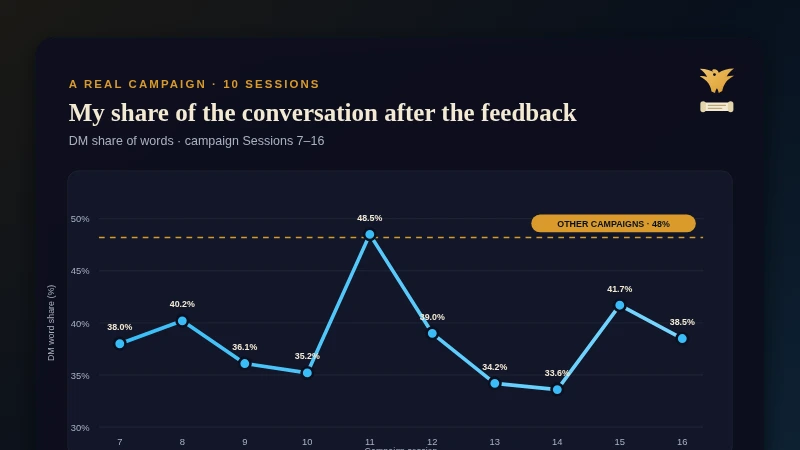
How much of a session does the GM spend talking?
You describe the world, play the NPCs and answer questions. You are going to talk. The harder question is whether your players have enough room to do the things they enjoy.
Remember, you are not writing a book. The players need room to make decisions, surprise you and shape what happens next. At a table of six, if the GM does most of the talking, it is worth asking whether the other five people have enough opportunity to influence the story.
A GM contributing 40% of the words leaves 60% for the players between them. That is a useful example to think about, rather than a target: describing a new city takes more GM talk than the party debating whom to trust. The question is whether your players get to make choices that matter.
That is where Recap Raven’s Moments feature comes in. It helps you see who contributed to the events that shaped the story, alongside how much each person spoke.
GMs on our platform use those figures to notice whom they might make more room for. I wrote about how much a DM should talk after my own players asked me to leave them more space. These conversations start with what the table wants.
Recap Raven Moments
Moments is Recap Raven’s own contribution metric, built on our campaign memory algorithm. It connects recorded story events with the people who helped shape them: a decision, a discovery, a promise or an action that changes what happens next.
Talking more does not automatically increase your moment count. A player can speak briefly, propose the plan everyone follows and make a lasting contribution to the adventure. Moments helps that contribution show up alongside the speaking figures.
Use it to see who is shaping the story and who might welcome an opportunity next session. It gives you another way to understand participation without treating the loudest voice as the most involved player.
Contribution
“Let’s offer to repair the bridge.”
Consequence
The party makes a deal and earns safe passage.
Moment
Recap Raven links that story event to the contributor.
Illustrative example of a contribution linked to a recorded event.
Using TTRPG statistics to improve your sessions
We want these figures to be useful beyond Recap Raven. GMs, players, creators and game designers all have questions about what happens at the table. Sharing what we can measure gives those conversations a common starting point.
If a pattern makes you curious, discuss it with your group. Try giving the players more room to plan, changing the size of a combat encounter, or returning to an unresolved promise. Then ask whether they enjoyed the difference.
There is plenty the numbers will never capture. The hope is that sharing them helps us ask better questions and learn from one another’s experience.
Free TTRPG data for articles, videos and research
Each data release includes its date range, method and downloadable aggregate data. Private campaign stories, names, quotes and GM notes stay out of those downloads.
Our published aggregate datasets on the statistics page use Creative Commons Attribution 4.0 International. You can reuse and adapt those datasets, including commercially, with credit to Recap Raven, a source and licence link, and a note of any changes.
The licence applies to those published datasets. It does not grant rights to customer stories or product screenshots. Downloads and citation text are available on the statistics page.
Is your table having fun?
Ultimately, these are just statistics. A typical session length or GM word share cannot tell you whether your game was a good one. Your table might look very different from the average and love every minute.
We find the patterns interesting, and we hope you will too. Explore Table Insights, see what makes you curious, and talk about it with your players. If everyone is having fun, that is what matters most.
Sources and method
Sources checked on 10 October 2026.
Frequently asked questions
Are the statistics only about D&D?
No. The combined view covers tabletop RPG sessions played with Recap Raven. System-specific results are labelled separately.
Can I use the statistics in an article or video?
Yes. Our published aggregate datasets are available under CC BY 4.0, with downloadable data and a suggested citation. Credit Recap Raven, link to the source and licence, and note any changes you make.
Do the statistics update every day?
We publish dated snapshots periodically. That gives readers a stable version to cite and compare.
Try free recaps for your own campaign, then explore the session analytics available on paid plans.
Free Tier includes 5 Standard sessions in your first 30 days, then 1 every 30 days, each up to 3 hours long, with best-effort multilingual support. A title, short summary and scenes, with basic AI and standard transcription quality. Premium adds richer recaps, PDF exports and GM insights; Memory plans add campaign Ask.